Journey through the province of Brescia, within one of the most intensive livestock systems in Europe. The (multi-species) meat supply chain is supported by infrastructures, water and logistics networks that shape a complex landscape centered around animal production
This article is part of a special project by giornaledellarchitettura.com, developed in collaboration with the research team led by Sofia Nannini at the Politecnico di Torino. The focus of this initiative is the in-depth exploration and dissemination of the results of an innovative and highly topical program, with an international perspective and approach. “Animal Farm: An Architectural History of Intensive Animal Farming (1570–1992)” examines the (hidden and often overlooked) spaces of the livestock industry, along with its paradoxes and impacts. It offers a cross-cutting interpretative framework that sheds light on key and decisive aspects of contemporary societies, economies, and landscapes.

The territories of meat are places where every living being, human and non-human, is systematically put to work. They cross the Po Valley without revealing themselves, scattered among cultivated fields, agricultural sheds, and back roads, never appearing as unified systems. These are the landscapes of intensive livestock farming, landscapes of maximization and automation, such as those analyzed by Víctor Muñoz Sanz (TU Delft). Hidden in plain sight, they manifest not only as land and physical infrastructures, but as complex systems of relationships, infrastructure, and production processes.
Within them, a specific kind of extraction takes place — one that concerns not only ecological components, but also living bodies. The animal species that inhabit them, though marginalized in forms of political and cultural representation, are an integral part of them and are subject to productive logics that regulate their existence and value. In this sense, as historian and philosopher Benedetta Piazzesi observes, animals constitute a constant presence in the history of disciplinary and biopolitical devices, in which technologies applied to animal and human bodies intertwine. Space, in this sense, is not only inhabited by humans and non-humans, but is produced by these asymmetrical relationships, becoming a platform for biopolitical extraction, as Nicole Shukin explores in Animal Capital, where animal life is continually managed, measured, and transformed into economic value.
Geographies of Dependency
In the Po Valley, and particularly in the province of Brescia, intensive livestock production takes shape within a landscape organized by water networks, agricultural corridors, and logistical infrastructure. The proximity of livestock farms, processing plants, and dedicated croplands has contributed to the development of one of Europe’s most intensive livestock systems. The main tributaries of the Po (the Oglio, Mella, and Chiese) flow through areas with high livestock density, highlighting the structural link between ecological networks and livestock production. The concentration of farms along these waterways demonstrates how the geography of intensive livestock farming depends on the ability to capture, distribute, and manage water flows on a regional scale.
“What you depend on defines a territory,” writes Bruno Latour. Applied to the province of Brescia, this perspective allows us to interpret the rural landscape as a complex construct, in which infrastructure, water networks, and logistics systems support the meat supply chain. The territory does not present itself as a neutral backdrop, but as an operational platform where production and spatial organization intertwine.
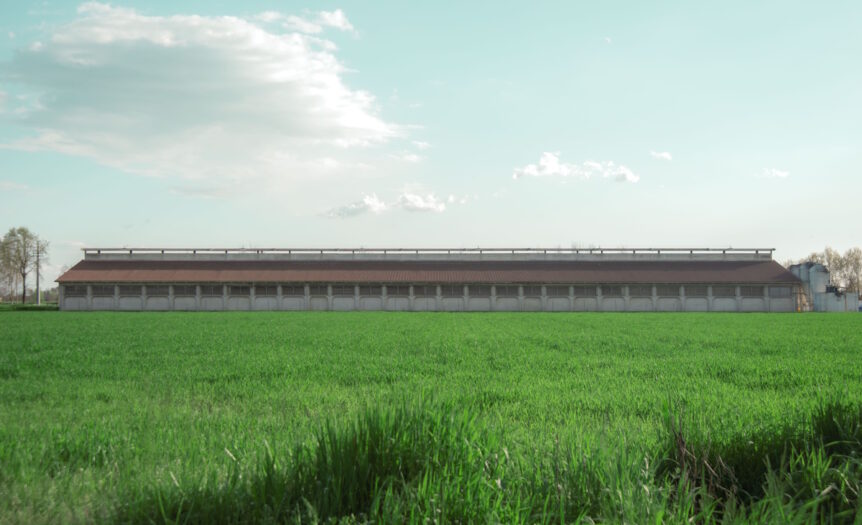
The meat production ecosystems in the province of Brescia are organized into territories shaped by the interplay of spatial structures and ecological dependencies. These are spaces where livestock farming areas are nestled amid expanses of cornfields and connected by transportation infrastructure and water networks.
Mapping the System
When we examine this system through its infrastructure—which enables and sustains its operation—a key lens for interpretation emerges: water. An opaque, trans-scalar element that permeates and organizes the phenomenon.
Maps allow us to visualize this reality, highlighting not only the distribution of livestock farms but also the relationships that connect them. Feed flows, wastewater disposal systems, and connections between farming, processing, and distribution compose a picture that shows how the entire landscape is structured around animal production. In this sense, the Brescia plain can be interpreted through the lens of the “livestock hinterglobes” developed by Nikos Katsikis, presented at the Cowborgs in the Polder symposium and in the exhibition CONVIVIUM: Food Systems at the Limit. They are operational territories of animal production, where infrastructure, ecologies, and industrial processes intertwine to the point of making the landscape a continuous platform for the livestock supply chain.
The territorial system is defined as a network of infrastructure that connects and organizes territories and processes. Water networks, treatment plants, crops grown for animal feed, and logistics networks all contribute to shaping a continuous space in which soil, water, and air are constantly involved in production processes.
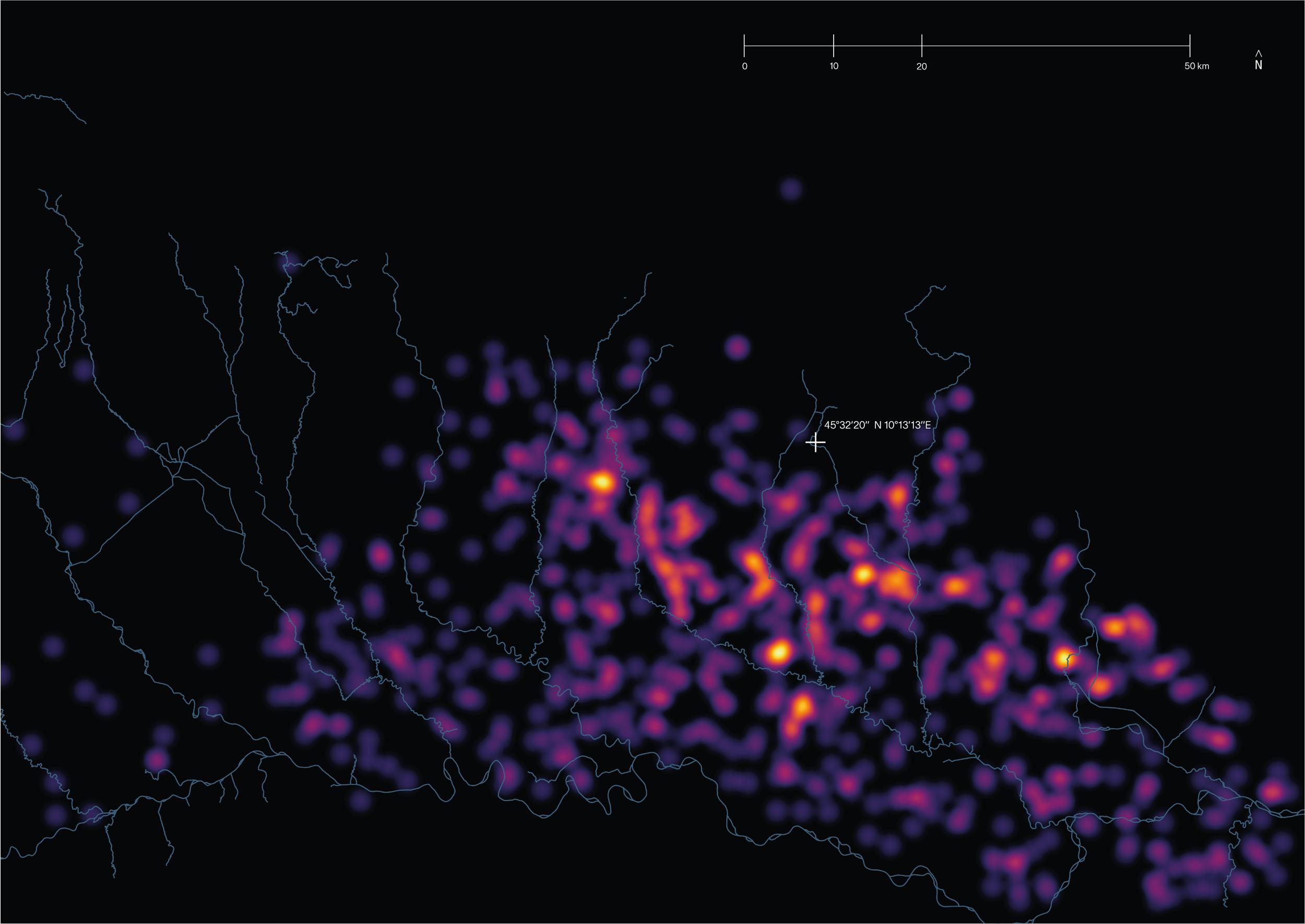
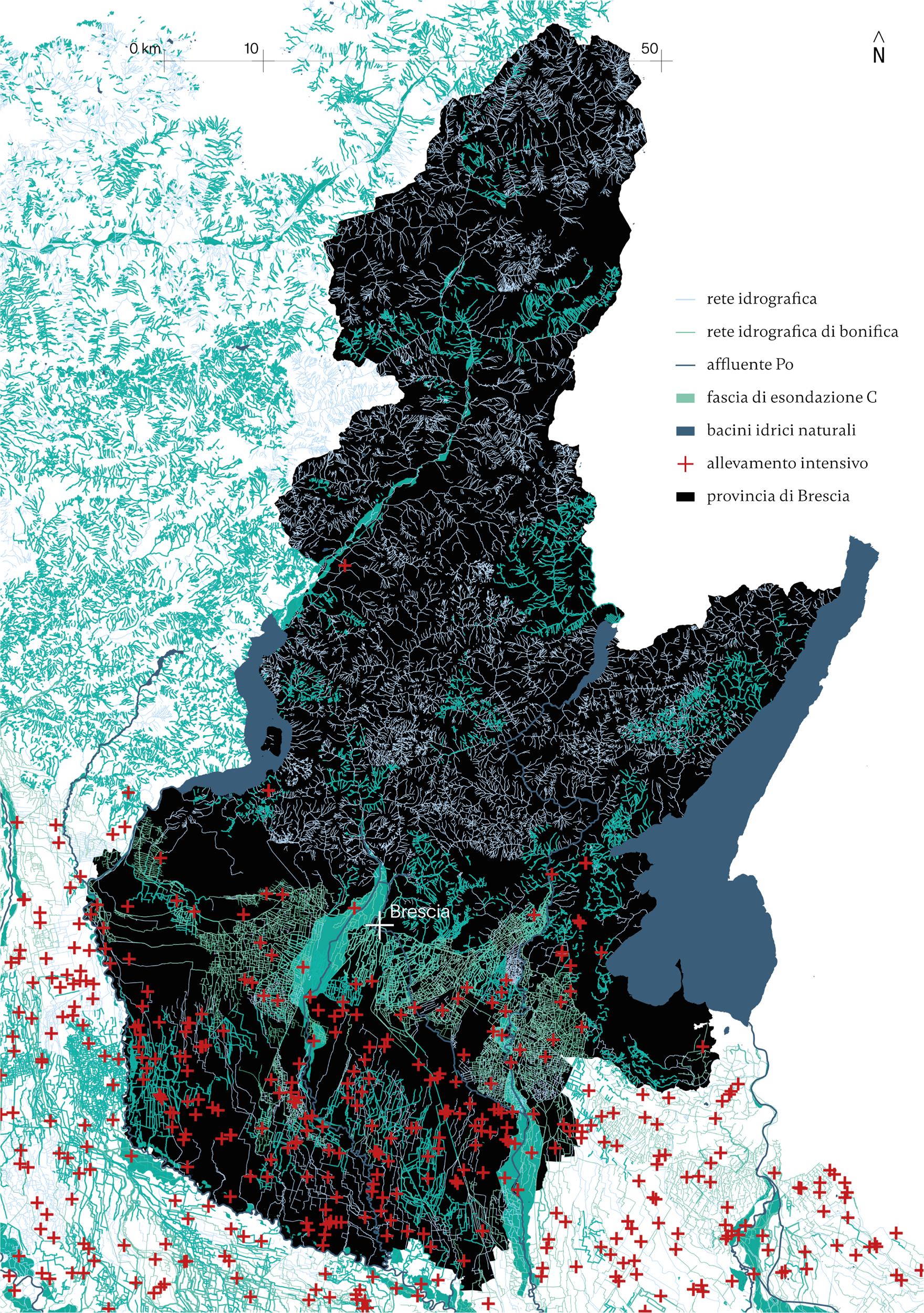
A Livestock-Dense Province
Lombardy has often been described as a “livestock-dense region,” where in many municipalities the density of livestock exceeds that of the human population, creating conditions of ecological pressure and livestock saturation. Within this context, the province of Brescia stands out for its high production intensity: ISTAT data and recent analyses by the Livestock Registry show that numerous municipalities have some of the highest livestock concentrations in Europe, reflecting a highly specialized system deeply rooted in the local area.
This area has one of the highest livestock densities in Europe: over 1.3 million pigs, hundreds of thousands of cattle, and several million poultry distributed across the Brescia plain. This concentration of animals corresponds to a high degree of agricultural specialization in the region, where over 70,000 hectares are planted with silage corn, intended almost exclusively for livestock feed.
Towns such as Calvisano, Ghedi, Manerbio, Chiari, and Isorella have become veritable livestock hubs, where animal density far exceeds human density and various production chains coexist within the same geographical area. The concentration of livestock farms also places significant pressure on environmental systems, particularly on water systems and wastewater management, highlighting the link between intensive livestock farming, land use, and the ecological transformation of the territory.
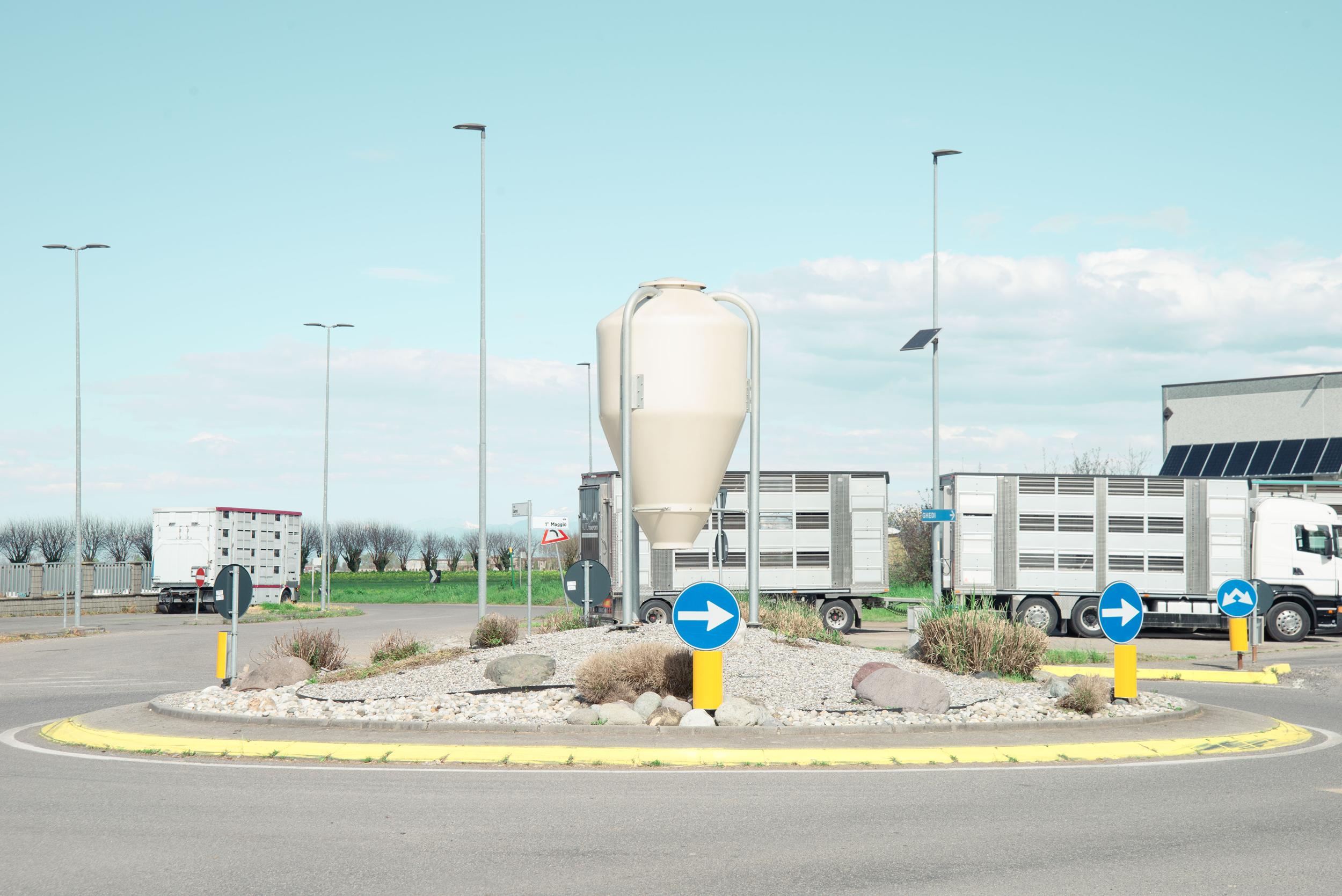
This territorial system finds its symbolic representation in the monumentalization of a feed silo situated at the center of a roundabout—a logistical hub and, at the same time, an emblem of the centrality of livestock farming in the configuration of the territory.
Postcards from a Multispecies Province
What does the intensive coexistence of multiple animal species within a highly developed livestock system entail from a territorial perspective? What spatial effects does it produce, and what forms of pressure and erosion does it generate on the ecological systems that make it possible?
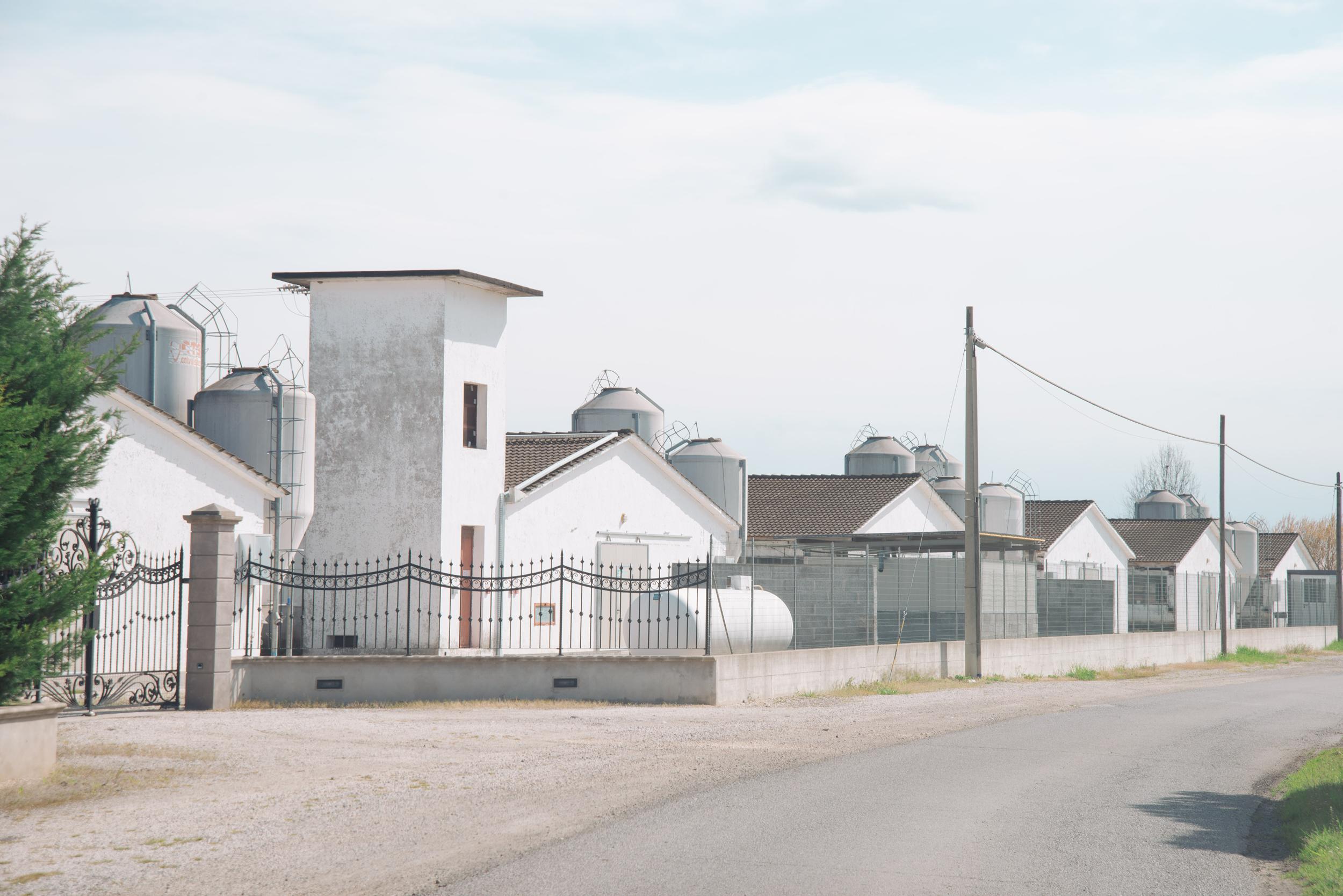
The territory appears to be arranged and progressively adapted to multi-species livestock farming, as if it had organized itself to accommodate different forms of animal production. Logistical friction tends to decrease, while water networks, along with other infrastructure, are integrated into a system designed to continuously support production, adapting to the needs of different species. In the case of the province of Brescia, and particularly in the Calvisano area, we observe a configuration in which various sectors—cattle, swine, poultry, and fish—coexist within the same territorial fabric. Interdependencies and, at times, forms of synergy emerge among these sectors, as in the case of the Calvisano Steelworks and the sturgeon farm producing caviar.
These multispecies territories are characterized by asymmetrical relationships that reflect logics of optimization and exploitation. Thus, we can speak of a veritable multispecies livestock infrastructure, which produces ecological and territorial effects that are fully visible but difficult to recognize as a system, as anthropologist Alex Blanchette demonstrates in his book Porkopolis. The territory, therefore, is not merely the backdrop for production, but its primary mechanism. Recognizing this means making the relationships that structure it visible and opening up the possibility of rethinking them.
Immagine di copertina: il paesaggio tra allevamenti e campi di mais, Brescia, Lombardia (© Alice Morena, Simone Nebbia)
- Article in Italian: Nascosti, in piena vista: il paradosso dei paesaggi degli allevamenti padani
- Read full “Anilam Farm” Repository
Autore
About Author