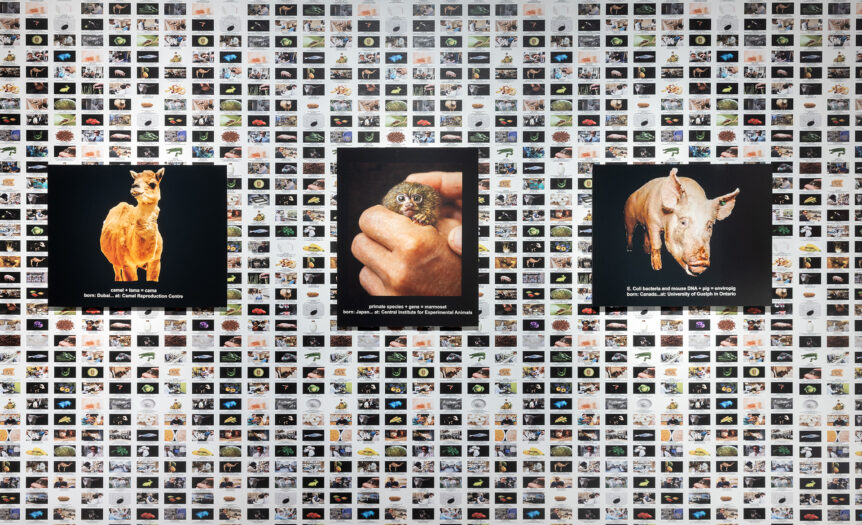
Critical review of an exhibition currently on view at the National Museum of Contemporary Art in Athens. “Why Look at Animals?” provokes emotion and raises questions.
This article is part of a special project by giornaledellarchitettura.com, developed in collaboration with the research team led by Sofia Nannini at the Politecnico di Torino. The focus of this initiative is the in-depth exploration and dissemination of the results of an innovative and highly topical program, with an international perspective and approach. “Animal Farm: An Architectural History of Intensive Animal Farming (1570–1992)” examines the (hidden and often overlooked) spaces of the livestock industry, along with its paradoxes and impacts. It offers a cross-cutting interpretative framework that sheds light on key and decisive aspects of contemporary societies, economies, and landscapes.

ATHENS (GREECE). On the façade of the EMST museum stands a neon sign that says: DO NOT FORGET THE WORLD TO COME. I read it quickly as I cross the busy traffic of Andrea Syngrou Avenue, but I don’t give it much thought. Somehow my mind labels it as the usual cryptic sign to be found in contemporary art museums. I walk around the corner of the building and enter. I am here in Athens to visit Why Look at Animals?, an exhibition that was recommended to me by many colleagues in the fields of architecture and the visual arts. The exhibition borrows its title from the famous essay by John Berger, published in 1980, which contemplated the disappearance of animals and the mutual human–animal relationship beyond capitalist means. I am curious about this show, but I don’t know what to expect.
Once you get your ticket, you quickly realize that this is not an ordinary exhibition, confined to the gallery space for temporary events. On the contrary, Why Look at Animals? has taken over the entire museum, from the ground level to the top floor. It includes dozens of installations by international artists, carefully orchestrated by the curator Katerina Gregos, who is also the artistic director of EMST.
Visitors are welcomed by a bold exhibition statement that underlines “the need to recognise and defend the lives of non-human animals in an anthropocentric world that marginalises, oppresses and brutalises them”. Like Dante Alighieri climbing the Purgatory mountain, the exhibition starts with a gloomy tone on the lower ground floor, where various artists reflect on the unbalanced relationship between animals and humans in the framework of industrial, colonial, and scientific exploitation. Here, the visitor’s gaze is inquisitory and renders visible the hidden presence of livestock in the cogs of modernity. Then, going upwards, the works slowly acquire an increasingly joyful tone that addresses the survival of wildlife in urban ecologies, animal movements, creativity, and communication. Why Look at Animals? has been extensively reviewed by many journals (Lampoon Magazine, E-Flux, Art Review, even Domus). My purpose here is to comment on a specific, yet underlying concept that embraces many of the art installations: the built environment and the materiality that sustains the human exploitation of animals.
The Cage
The cage is the most basic design unit that materializes the unequal relation between humans and animals: it divides us from them; it forces their movement and behaviour. The cage is a pervasive and recurring element, from factories to homes: songbird cages, battery cages, sow crates, fences. It is the materialization of human dominion over non-human lives. Yet, as Italian philosopher Benedetta Piazzesi puts it in her book Del governo degli animali, the cage can also be seen as the negative symbol of the resistance of animals against humans.
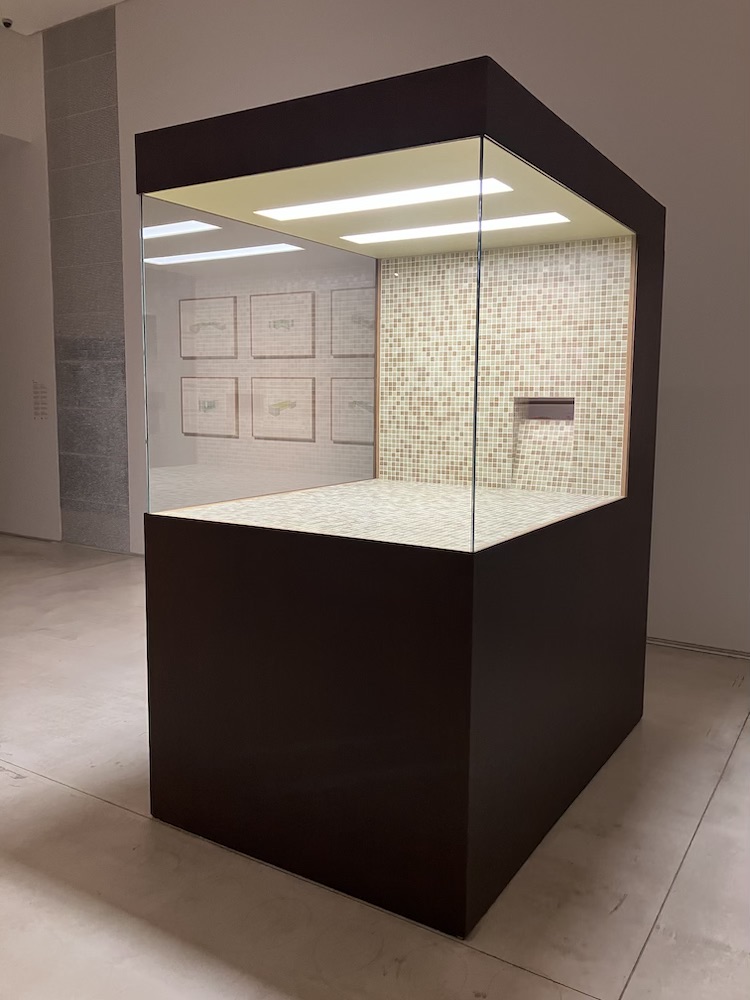
Why Look at Animals? is full of installations that evoke the powerful presence of the cage. On the ground floor, Belgian artist Wesley Meuris presents a set of drawings that illustrate the taxonomical variety of caging and fencing systems for different species, almost as if they were architectural typologies. A model, titled Enclosure for Animals (Zoology), shows the cold efficiency of the cage: an abstract space, covered in hygienic ceramic tiles, brightly lit from above. There is no animal inside, but if there were, they would have no place to hide from our gaze.
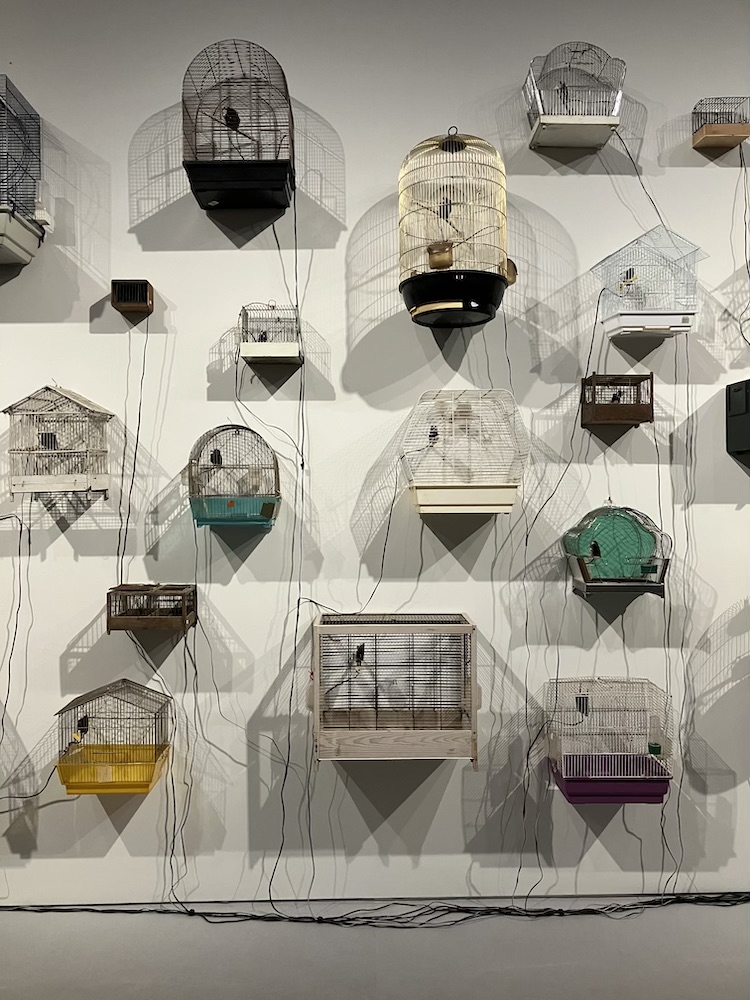
On the top floor, just before the end of the exhibition, Algiers-born artist Oussama Tabti creates a vertical landscape of empty birdcages, as if just abandoned by their inhabitant, the goldfinch. Inside each cage, a speaker transmits the human imitation of the goldfinch’s song. The work attests to an inversion of roles, an omen. The caption to the work asks: by caging the birds, have we humans caged ourselves too?
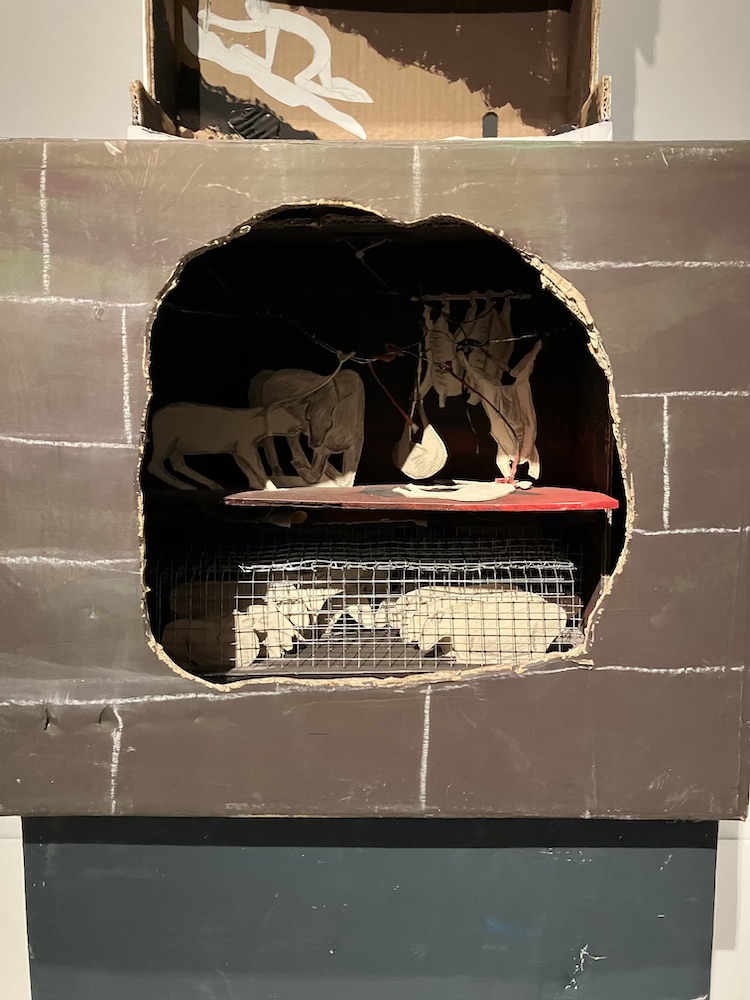
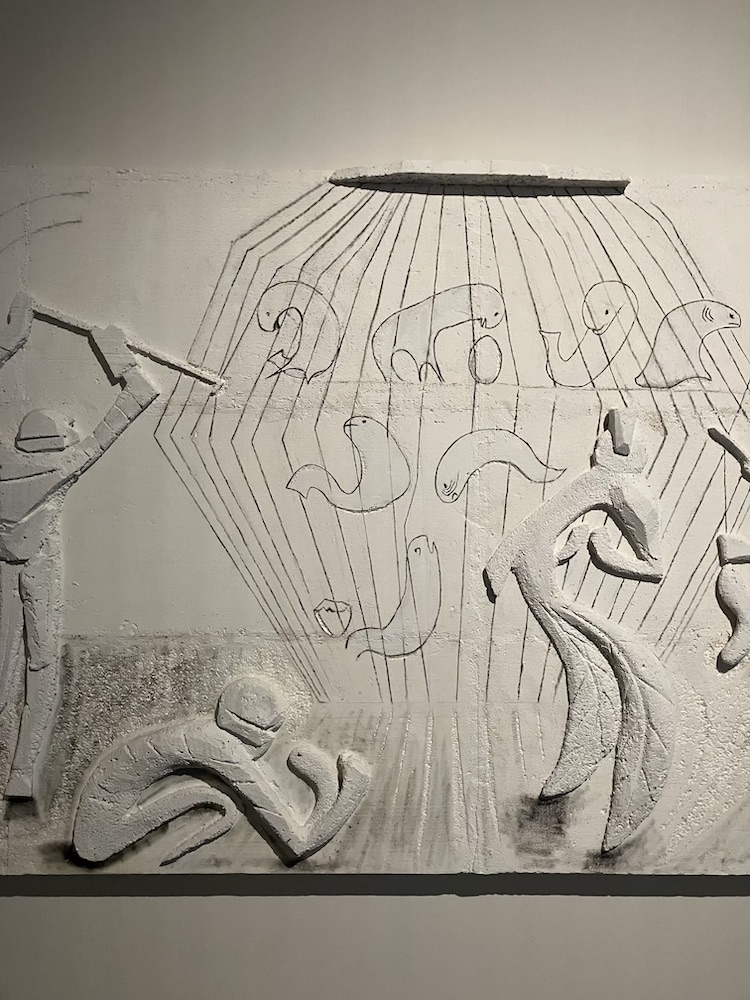
Yet, the cages are not eternal: they can be easily dismantled. The delicate works of Lin May Saeed prompt visitors to reject the cage as a fixed mediator of the human-animal alliance. Her bricolages made of Styrofoam and acrylic paint illustrate both a dystopian reality, where caged livestock is seen as the base of the skyscraper of capitalist exploitation, and the utopian dream of humans opening up the bars to the liberation of animals (and thus, of humans too).
The Factory
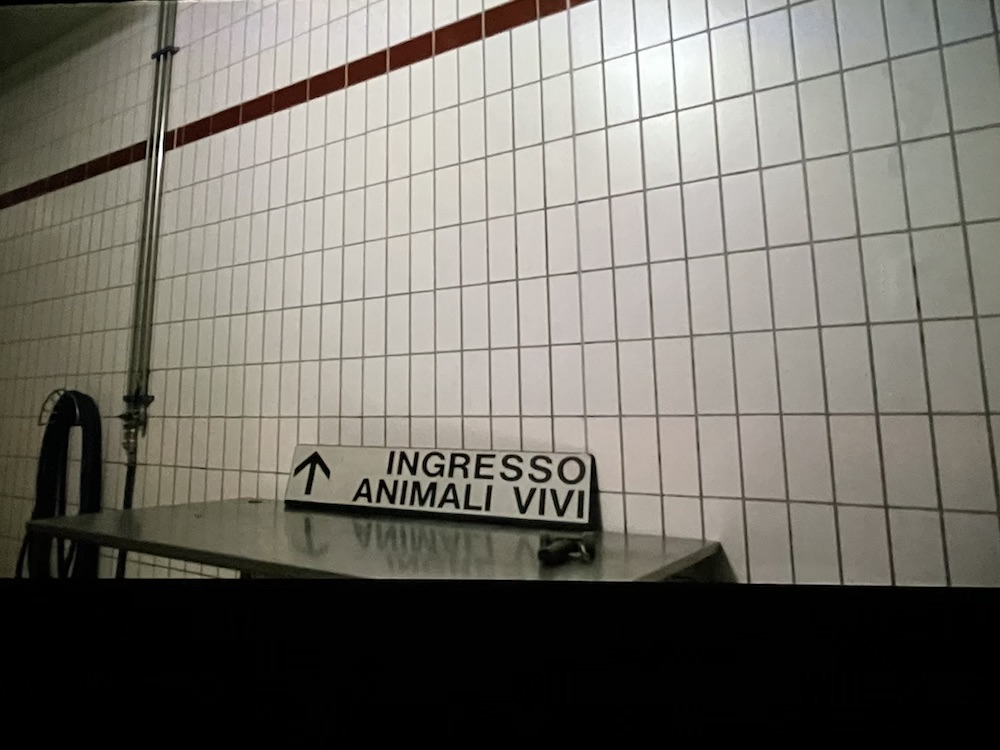
If the cage is the basic unit of animal exploitation, the factory is the operational environment where livestock is born and raised, killed and rendered for human purposes. The walls of the factory farm, and those of the slaughterhouse, are the only horizon granted to farm animals. The video installation “Ingresso Animali Vivi” by Croatian artist Igor Grubić describes the eerie space of a former slaughterhouse in Italy, as seen through the eyes of a dog walking across the empty rooms. Similarly to the enclosures by Wesley Meuris, the tiled walls are a reminder of the cleanability of architecture against the traces of blood.
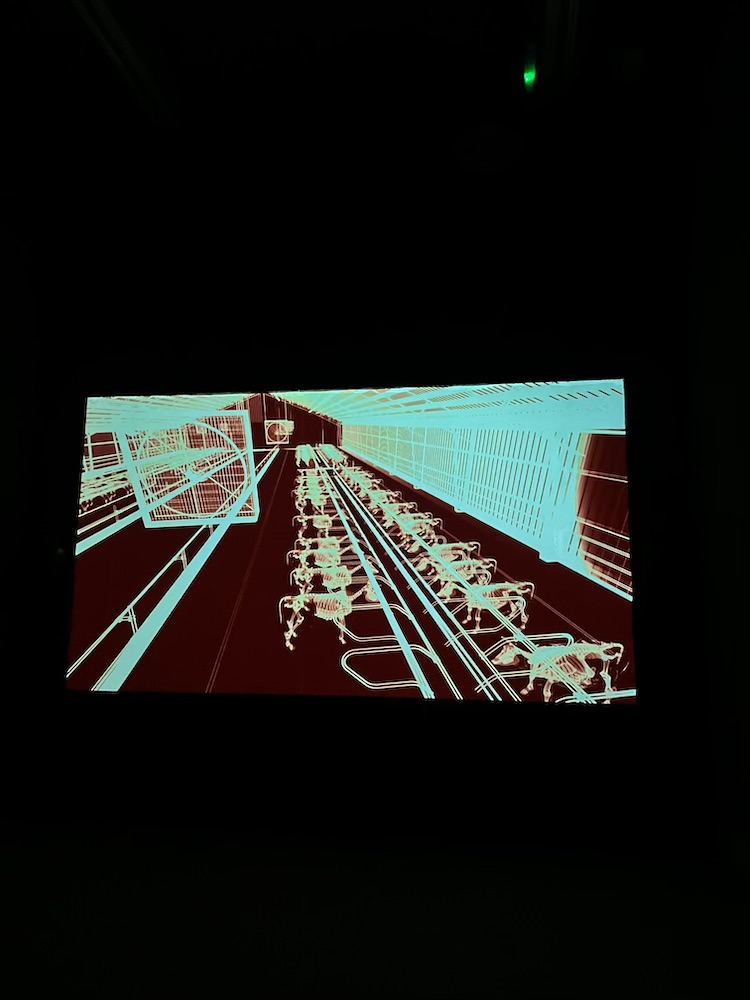
Sometimes, Grubić’s camera turns away from the slaughterhouse and describes the spaces of the factory farm. By switching to negative images, Grubić leads us to an environment populated by see-through skeletons: the bones of the cows, the metal frames of the sheds, the steel cubicles and the ventilators. It is the mechanized zootechnical environment in its full Taylorist capacity.
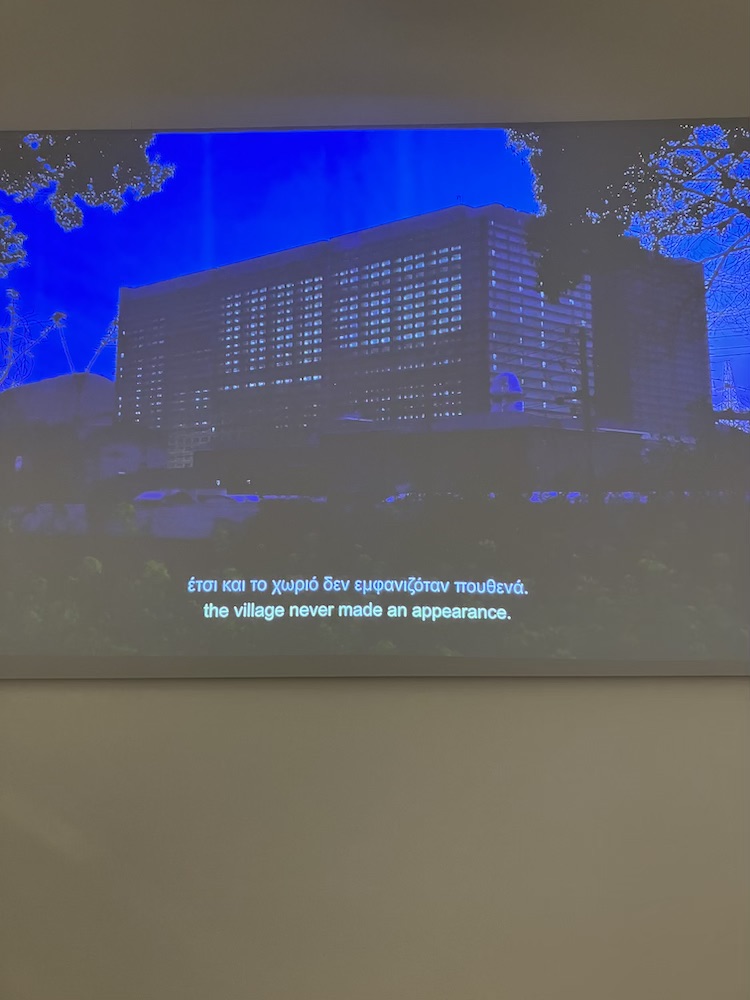
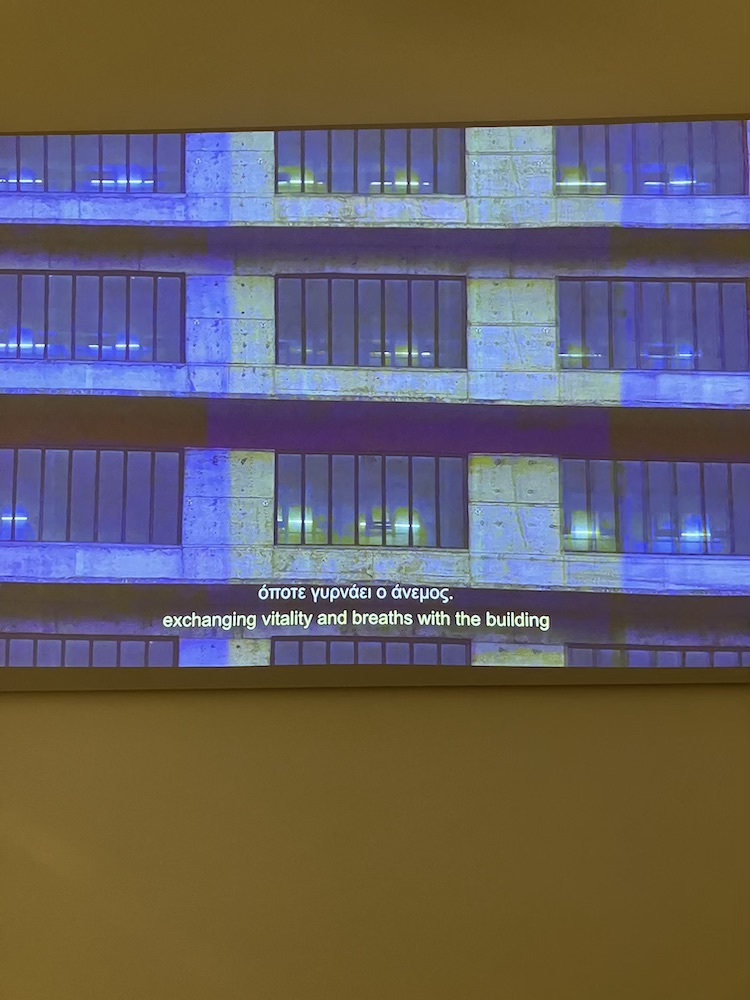
As anthropologist Alex Blanchette writes in his outstanding book Porkopolis (2020), the zootechnical industry and the animal agribusiness are “the tangible realization of totalities”. The ambition of an industrial totality that embraces human and animal life is brilliantly narrated in the video installation High-Rise Pigs, by Singapore-born artist Ang Siew Ching. The documentary reflects on a 26-storey pig farm in the Hubei province in China, and its impactful presence in the nearby rural village. The two entities—the village, with its small houses and agricultural fields, and the factory, with its heavy concrete mass and polluting smells—“exchange vitality” and attests to the controversies of today’s food production. What is left of architecture when humans dare to design a building capable of rearing and slaughtering more than 1.2 million pigs every year?
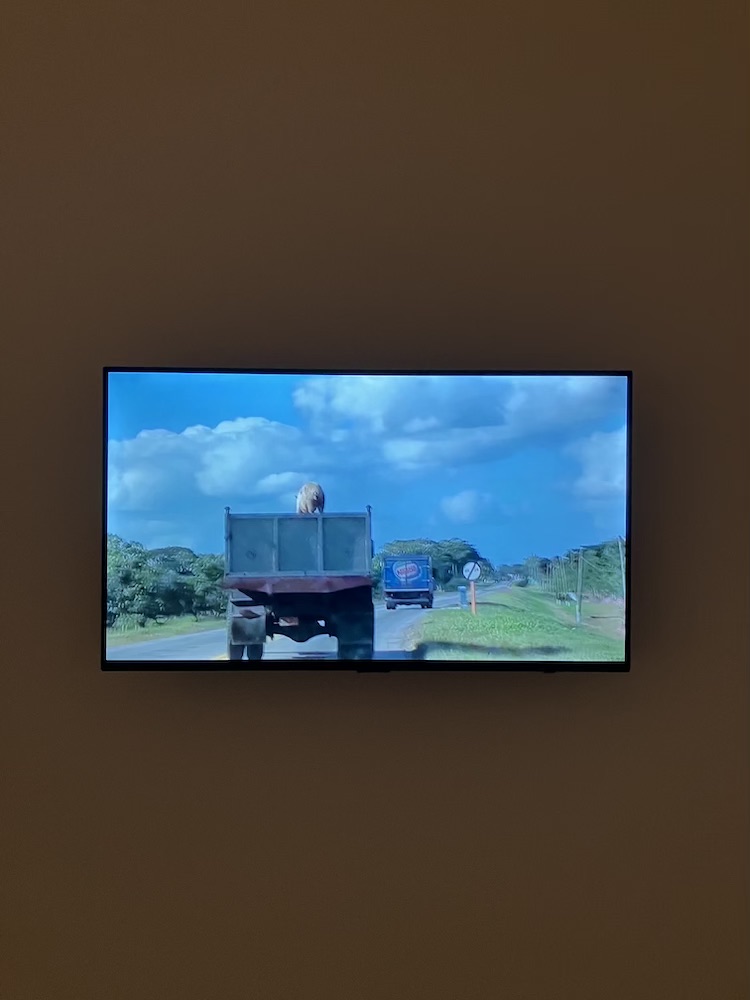
After seeing this documentary, I turn to the found footage shown by Italian artist and activist Tiziana Pers, titled Saut dans le vide. The short clip catches the escape of a pig, who jumps out of the truck that is presumably driving to the slaughterhouse, and then falls onto the side of the road. I was expecting this footage: the image of the flying pig is the featured image of the entire show on the EMST website. I watch the clip several times. It is both liberating and painful: you end up cheering for this one pig capable of escaping the infrastructural boundaries of industrial production. Yet, you are left with many questions: was she hurt? Did she escape, for real?
On animals, on us
After spending more than four hours in the museum, I am left with many conflicting emotions. The exhibition reminds me of what American anthropologist Barbara Smuts wrote as a reply to J. M. Coetzee’s The Lives of Animals: when we speak about animal rights, we ultimately speak about animals and our relations with them, as well as about us humans and our own uneven relations of power.
In the very last room of the show stands a neon sign that translates, into Greek, the motto I have already seen on the façade.
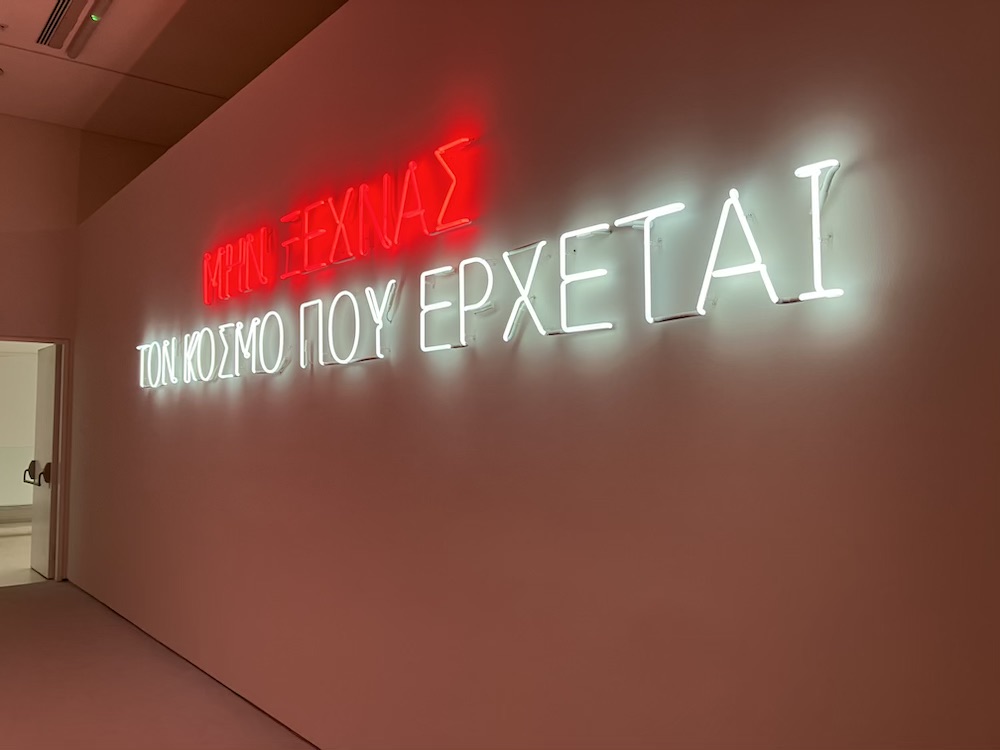
I learn that it was commissioned from Tiziana Pers and that it serves “as a reminder for collective responsibility in light of our common future and that of the future of the coming generations”. The artists and curator of EMST seem to be courageously claiming that the world to come which we should not forget is a world in which non-human lives are considered equals with whom we coexist on this planet.
The open question to architects and designers is: how can humans design an environment for domesticated animals beyond the material constraints of the cage and the economic ends of the factory? As Italian architect and researcher Lisa Carignani writes in this book on Rome and wildlife, how can architecture turn to the values of anti-speciesism for a redefinition of design beyond anthropocentrism?
Cover image: EMST Atene “Why Look at Animals?”, Lynn Hershman Leeson, The Infinity Engine, 2014 (© Paris Tavitian)
“Why Look at Animals? A Case for the Rights of Non-Human Lives”
Curated by: Katerina Gregos
16 May 2025 – 16 April 2026
National Museum of Contemporary Art Athens (EMST)
Athens
Info
Autore

About Author