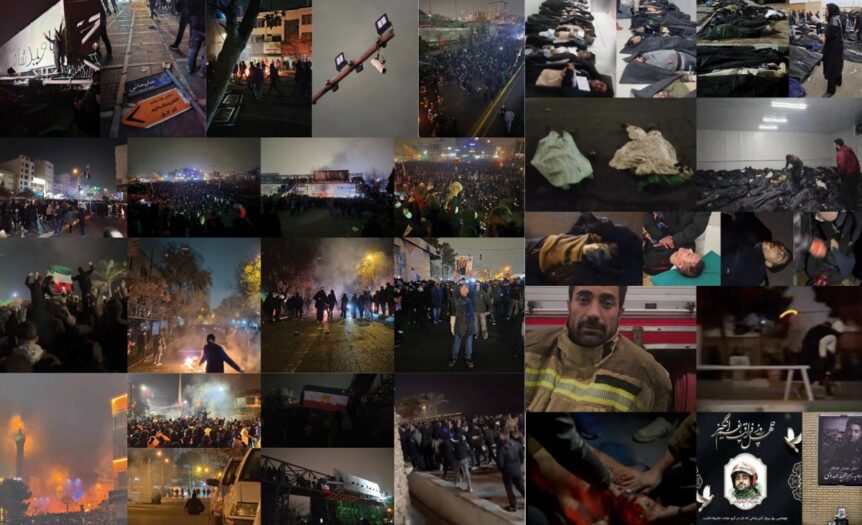
A impactful testimony from two young students: in Iranian cities, now at war, destruction is also semiotic: it alters spaces, homes and rituals, transforming places into non-places. The ethics of urban landscapes are overturned and architecture is a tool for understanding repression.
As a (new) war unfolds in Iran and involves the entire Middle East, two Iranian students enrolled in an Italian architecture School have written a passionate and powerful testimony for us, which must remain anonymous. Their chosen title is emblematic of their perspective on their homeland: “The Inversion of Meaning: The Massacre of the Right to the City Leaving Iran in a Semiotic Ruin. By two Iranian students whose hearts and souls still go on for a free Iran despite the distance. For all the innocent lives that were taken mercilessly”.We are spreading this text as a necessary form of participation and awareness.
What can happen to a city when it’s architecture, urban design, rituals, and all human-made systems that are designed and developed to create order and discipline and organization, lose their meaning and their logic and in some cases even invert into something completely different or opposite of their initial purpose?
What strong force can severe these objects and places from their logic and initial meaning and existence?
The events of January 2026 in Iran have forced an urgent re-evaluation of the relationship between power, space, and meaning. Architecture, traditionally defined as the art of sheltering and organizing human life, has undergone a violent transformation into a tool of liquidation and lost its original purpose. In the hands of the current Islamic regime in Iran, the built environment has been stripped of its human-made logic, leaving behind a landscape where every object and every space now signifies the opposite of its intended purpose.
This Semiotic Ruin begins at the city’s historic core and extends into the most intimate layers of the domestic interior.
Rasht Bazaar: From a Lively Market to a Mass Grave
In architectural theory, Semiotic Ruin describes a condition where a structure’s physical form outlasts its cultural or functional meaning. It is the “entropy of information” rather than the “entropy of matter.”
The core idea and the conceptual backbone that form persists while meaning decays comes from Umberto Eco who argues that signs can outlive the cultural codes that render them intelligible, remaining materially present while becoming opaque or unreadable (A Theory of Semiotics, 1976). When applied to architecture, this implies that buildings may endure physically even after the social logic that once animated them has dissolved.
Urban meaning, as Kevin Lynch demonstrates in The Image of the City (1960), depends on shared legibility and collective mental maps. Cities can therefore lose meaning without undergoing physical destruction. In this context, a semiotic ruin is not a collapsed structure, but a building that no longer “speaks” its original language.
In this context, semiotic ruin is not a collapsed building but a building that no longer “speaks” its original language. While a traditional ruin involves the literal crumbling of stone, a semiotic ruin occurs when the signifier (the building) remains intact, but the signified (its purpose or social message) has evaporated or become illegible to the public.
This collapse is quite visible in the Bazaar of Rasht (city in Northern Iran), historically the epicenter of civic life and economic flow. When the merchants initiated a strike, a peaceful “closing” of the city’s heart, the state responded with an act of violence. By locking the gates of the Bazaar and setting the historic structure on fire, the state re-coded an architecture designed for circulation and daily life vibrant activities into a mass grave. The gate, a symbol of protection for the merchant, was turned into the mechanism of their entombment. This inversion of the marketplace parallels the traumatic distortion of national defense. During the eight-year Iran-Iraq War, Iranian identity was forged in the defense of the “National Skin” against an external invader.
Today, that skin has been punctured from within; the state has invited foreign militias to enter the domestic “living room” of Iranian cities and armed them to suppress its own citizens even in some cases offered them the Iranian women protestors as treaty. When foreign forces are utilized to bypass the potential hesitation of local conscripts, the concept of the “National Defender” loses its meaning. The military no longer guards the border; it guards the regime against the border’s inhabitants, erasing the moral distinction between security and occupation.
Rights Denied
This spatial betrayal is facilitated by a deliberate forced and programmed control by the Islamic Regime, a strategy of information deprivation that has evolved over decades. In the 2000s, this purge targeted the rooftop, where security forces destroyed satellite dishes to sever the household’s link to the world. Today, the technology has shifted to the fiber-optic cable, but the logic remains identical. By enforcing a total internet shutdown for two weeks straight, the regime has “unplugged” the modern home, reducing the smart-city to a pre-modern box of silence. In this darkness and internet shutdown the home is no longer a sanctuary of privacy but a securitized cell. Yet, in a defiant counter-spatial move, citizens have re-coded their private rooms into clandestine shelters and triage centers, reclaiming the Right to the City within the very walls the state seeks to isolate.
For Henri Lefebvre (1968), the “Right to the City” is not a mere legal access to urban resources, but a collective demand for inhabitants to actively appropriate and transform urban life, prioritizing the “use value” of shared space over the restrictive “exchange value” imposed by the state or capital.
The degradation of meaning reaches its most harrowing point in the assault on human rituals. The state’s requirement that families provide packets of sweets, celebratory objects, to ransom the bullet-ridden bodies of their children is a form of symbolic torture that forces a performance of joy at the peak of grief. This moral inversion is mirrored in the use of the Kafan (shroud) on the bodies of the living. To wrap a dissident in the garment of the grave while they still breathe is to perform a social death before the physical one. It is the final minimalist architecture: a skin that signifies the citizen is already a ruin in the eyes of the law.
Such inversion recalls Roland Barthes’s analysis of myth as a process by which dominant power strips signs of their original meaning and re-inscribes them with ideological violence (“Mythologies”, 1972).
These spatial shifts are punctuated by harrowing accounts of survival within the “securitized cell”: reports of a severely injured citizen remaining silent inside a kafan (shroud) for three days to evade execution; auditory testimonies of moaning heard from within state morgues; and the account of a father who, while searching for his son’s remains, discovered a living stranger among the corpses and bribed officials to claim him as his own, effectively “purchasing” a life from the machinery of death.
These acts represent the ultimate, desperate reclamation of the “Right to the City” at the threshold of the grave.
Non-Places Landscapes
Ultimately, Iran has become a landscape of non-Places.
Azadi Square is no longer about freedom, the Police are no longer about safety, the Home is no longer about privacy. For the international architectural community, this crisis is a warning of what happens when the logic of organization is replaced by the logic of annihilation. We are witnessing the birth of a Post-Meaning City, where the only truth is the physical resistance of bodies against a built environment and regime that has been turned entirely against them. As Marc Augé describes, non-places are spaces emptied of relational, historical, and symbolic meaning (“Non-Places”, 1995).
What emerges is a post-meaning city, where architecture remains physically intact yet ethically inverted.
Cover image: A collage of images of protests and repression in Iranian cities.
This text is published to give voice to and in the memory of: Hamid Mahdavi (Mashhad), Sepehr Ebrahimi (Tehran), Ghazal Janghorban (Isfahan), Parsa Saffar (Mashhad), Yazdan Tamana (Mashhad), Melina Asadi (Kermanshah), Abolfazl Norouzi (Mashhad), Bahar Hosseini (Neishabur), Negin Ghadimi (Shahsavar), Majid Farnia (Chalus), Faezeh Mostaan (Tehran), Naser Rezaei (Karaj), Mohammad Jabari (Karaj), Mani Safar Pour (Tehran), Raha Holulipour (Tehran), Mehrdad Moshtaghi (Arak), Mahdi Rahimi (Dezful), Diana Bahador (Gorgan), Bita Akbari (Isfahan), Morteza Shaneh (Sabzevar), Sepehr Shokri (Tehran). E alle tante altre anime coraggiose e innocenti il cui numero è ancora sconosciuto. Si stima che le persone uccise siano oltre 40.000).
Disclaimer sulle fonti e limitazioni dei dati: l’articolo affronta le condizioni sociali, politiche e istituzionali in Iran in un contesto in cui l’accesso a informazioni affidabili, verificabili e indipendenti è strutturalmente limitato. Quasi tutte le statistiche
Disclaimer on Sources and Data Limitations: this text addresses social, political, and institutional conditions in Iran in a context where access to reliable, verifiable, and independent information is structurally constrained. Almost all official statistics, public records, and media reports are subject to censorship, selective disclosure, retroactive alteration, or complete suppression by state authorities. As a result, several well-documented realities are not consistently reflected in sources that meet conventional academic standards of transparency and reproducibility. Where direct, citable documentation is unavailable, this paper relies on a triangulation of indirect evidence, including credible reports from international organizations, investigative journalism, archival material, firsthand accounts, and personal first-hand experience. The absence of publicly accessible sources should therefore not be interpreted as an absence of the underlying phenomena, but rather as a consequence of systemic information control which is one of the many reasons to protest. This disclaimer is intended to make explicit the epistemic limitations under which research on contemporary Iran is conducted and to contextualize the evidentiary gaps that necessarily arise in such an environment.
Autore

About Author